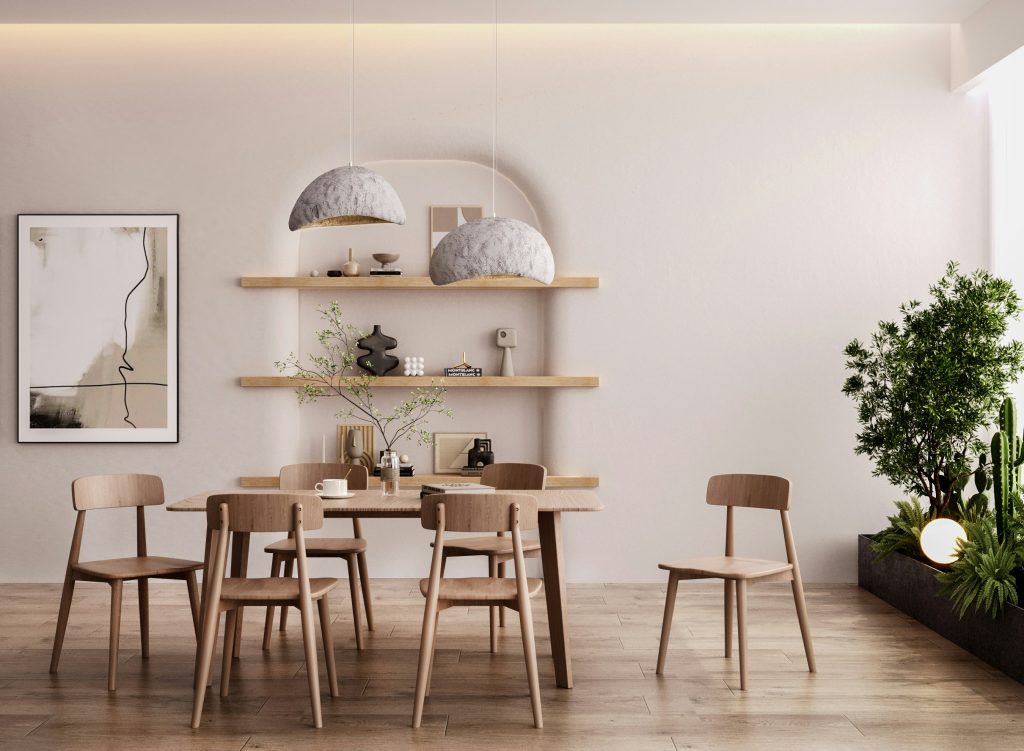
Wabi sabi interiors have moved from design blogs to mainstream American homes, and no state is better placed for the trend than Arizona. The style, built on a Japanese philosophy that finds beauty in imperfection, age, and natural materials, keeps appearing on 2026 trend lists as the answer to cold, glossy minimalism. Most of the country imports the look. In the Sonoran Desert, it reads like something that was already there, waiting for a name.
What wabi sabi interiors are, and what they are not
The idea is older than any trend cycle. Wabi sabi grew out of Zen Buddhism and the Japanese tea ceremony, where a cracked, hand-formed bowl was prized above a flawless one. As MasterClass explains in its guide to the philosophy, the tradition values modesty, asymmetry, roughness, and the passage of time, and treats age as something that deepens beauty rather than ruins it. Kintsugi, the practice of repairing broken ceramics with visible golden seams, is the idea in miniature: the crack becomes the feature.
In a home, that translates to natural materials that age honestly, handmade objects over mass-produced sets, muted earth tones, texture instead of shine, and rooms edited down to the things that matter. Just as important is what it is not. Wabi sabi is not shabby chic, not neglect, and not another shade of beige minimalism. It is also not a shopping category, though retailers now sell it as one. A room filled overnight with brand-new “wabi sabi decor” misses the point, because the philosophy is about patience and editing, not purchases.
Why Arizona suits the trend better than any other state
The desert teaches the same lessons the tea masters did. Materials weather visibly under the Arizona sun. Light, not ornament, does the decorating. And the state’s building tradition has always been material-honest: adobe, rammed earth, hand-troweled plaster, and wood that shows its grain and its years.
The strongest proof stands in Scottsdale. At Taliesin West, Frank Lloyd Wright’s winter home and studio, Wright built with what he called desert masonry, local rock set in forms and bound with cement and desert sand, so the buildings appear to rise out of the ground they sit on. Canvas roofs filtered the harsh light into something soft. His organic architecture, the belief that a building should grow from its site, is wabi sabi’s closest Western cousin, and he practiced it in Arizona decades before the term reached American design media.
The palette agrees too. Clay, sand, sage, faded terracotta, and sun-bleached wood are both the Sonoran color range and the wabi sabi one, which is why the style transfers into Phoenix, Tucson, and Sedona homes without the strained feeling it can have elsewhere. One honest caveat: the same sun that creates all that beautiful patina punishes delicate materials. Unsealed wood and fine linen belong away from hard western exposure, while plaster, stone, and clay take the climate in stride.
Bringing wabi sabi interiors home
The practical version starts with surfaces. Matte mineral and limewash finishes in warm whites and clay tones carry the look almost by themselves, and texture matters far more than price: even cheap wall paint in a flat, chalky finish reads more honest than expensive gloss. A single plastered or limewashed wall does more than a gallery of prints.
Then the materials. Linen and cotton that are allowed to wrinkle. One handmade ceramic piece where a matching set used to be. Vintage wood with its dents left in. Living finishes such as unlacquered brass that darken with every hand that touches them. Furniture repaired visibly rather than replaced quietly. The final move is editing: clear surfaces, negative space, and a few objects that earn their place, with sculptural native plants or a dried arrangement standing in for clutter.
Homeowners who want help translating the philosophy into an actual floor plan can bring in a professional. Online services such as Havenly match clients with US designers by style and budget and work remotely, which suits Arizona towns without much of a local design scene. The honest trade-off is that design help costs money, and wabi sabi is one of the few styles a patient owner can build alone, slowly, which is rather the point.
A wabi sabi starter list for an Arizona house
- Repaint one room in a matte mineral finish, warm white or clay
- Swap heavy synthetic curtains for sheer linen that filters the desert light instead of fighting it
- Choose one plaster or limewash accent wall over a wall of framed prints
- Replace a matching decor set with a single handmade ceramic piece
- Repair the wobbly chair instead of replacing it, and let the repair show
- Carry the interior palette onto the patio so inside and outside read as one space
- Clear one surface completely and keep it that way for a week before adding anything back
Frequently asked questions
Are wabi sabi interiors expensive to create?
No, and the expensive version usually defeats the idea. The philosophy favors fewer, older, and repaired things over new purchases, so decluttering and secondhand finds do most of the work. Handmade ceramics and natural textiles cost real money, but one good piece carries a room.
What colors work in wabi sabi interiors?
Earth tones with the saturation turned down: warm whites, clay, sand, muted sage and olive, and soft charcoal for grounding. In Arizona the swatch book is outside the window, and matching the interior to the desert palette makes the whole property feel continuous.
Is wabi sabi the same as Japandi?
They are related but not identical. Japandi is a style that blends Japanese and Scandinavian design, while wabi sabi is the older philosophy underneath the Japanese half. A Japandi room usually borrows wabi sabi ideas, but wabi sabi can live in adobe, farmhouse, or modern desert homes without a single Scandinavian piece.
Does wabi sabi work in a brand-new build?
Yes, with deliberate material choices. New construction lacks patina, so it has to be invited in: reclaimed wood, handmade tile, limewash, living metal finishes, and vintage furniture. Time supplies the rest, which in the Arizona sun does not take long.